New Australia-Wide Trial for Nerve Pain after Spinal Cord Injury
NeuroStim+ Trial: Investigating the efficacy of neuromodulation to decrease the severity of neuropathic pain in people with a spinal cord injury
Researchers at the UNSW NeuroRecovery Research Hub are leading a new Australia-wide clinical trial to find out whether two safe non-invasive techniques can help reduce neuropathic pain in people living with spinal cord injury.
Neuropathic pain is a common and often persistent complication after spinal cord injury. It is thought to be linked to changes in how the brain process pain.
What is the trial testing?
This trial is exploring two innovative, drug-free techniques designed to retrain the brain’s pain-processing networks:
-
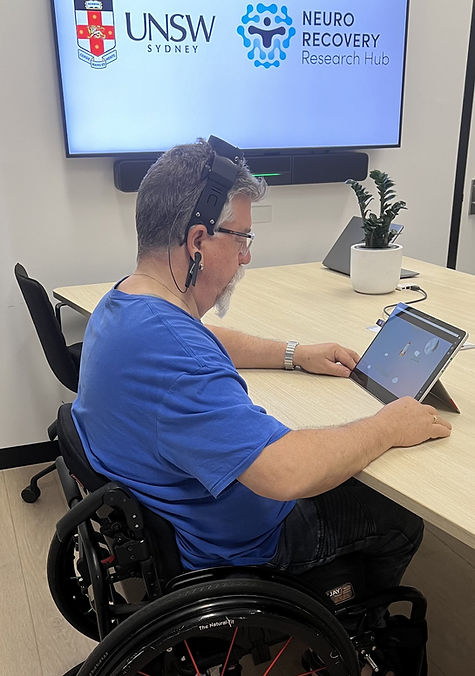
EEG neurofeedback – a method that uses real-time feedback from your brainwaves to help you learn to regulate your brain activity. The goal is to reduce the abnormal brain patterns linked to chronic nerve pain.
-
Transcranial direct current stimulation (tDCS) – a gentle, painless technique that applies a low-level electrical current to specific areas of the scalp. This may help change how the brain responds to pain signals.
Both approaches are grounded in emerging research showing that chronic nerve pain after spinal cord injury is associated with changes in brain activity.
The trial will assess whether using one or both techniques in a series of sessions can meaningfully reduce pain intensity and improve day-to-day wellbeing.
What is involved?
-
All trial activities are completed from home using equipment we provide.
-
You’ll be randomly placed into one of four groups and receive either:
- EEG neurofeedback and tDCS together, or
- tDCS on its own (using one of two different settings)
-
You’ll complete 20 sessions over 5 weeks, with each session lasting 30–60 minutes.
-
You’ll also complete five sets of online questionnaires over a 12-month period.
Optional brain scan (MRI and EEG)
You may also choose to take part in optional brain scanning. You will be reimbursed for reasonable travel and accommodation costs directly related to the study, up to a maximum of $350 per visit. In exceptional cases (e.g., long-distance travel), additional support may be considered on a case-by-case basis with prior approval from the study team.
Who can take part?
If you live in Australia, have a spinal cord injury, and experience nerve pain, you may be eligible.
Interested?
Please fill out our short expression of interest form and we’ll get in touch with more information.